Cybersecurity
South Korea's Digital Medical Device Cybersecurity Guideline: International Standards Gap Analysis & Market Entry Strategy
Why global FDA, EU MDR, and IEC 81001-5-1 baselines leave a 72.7% localization gap in South Korea—and a 4-phase strategy for SaMD and AI market entry.

Why Global Cybersecurity Compliance Leaves a 73% Gap in South Korea
Global SaMD, SiMD, and AI medical device developers often assume that compliance with IEC 81001-5-1, IEC 62443-4-2, ISO 14971, US FDA Section 524B, and EU MDR (MDCG 2019-16) transfers cleanly to South Korea. In practice, that assumption causes avoidable review holds, late architectural rework, and Digital GMP audit findings.
Although South Korea builds conceptually on IMDRF N60, N70, and N73 alongside IEC security standards, its legal structure differs fundamentally. Global regimes separate voluntary device standards from hospital IT governance (ISO/IEC 27001), regional privacy laws, and AI regulation. South Korea consolidates these obligations into a single legally binding statutory framework backed directly by administrative sanctions, license suspension risks, and statutory fines—extending even to digital medical devices integrated within digital convergence pharmaceuticals.
Equally critical, MFDS enforces these duties simultaneously across four regulatory gates:
- Clinical Investigation Approvals: Foundational security readiness enters review prior to clinical study authorization, not solely at commercial filing.
- Premarket Technical Review: Reviewers assess core cybersecurity alongside mandatory AI defenses, checking strict alignment across architecture diagrams, test evidence, and labeling.
- Digital GMP Audits: Dedicated electronic-intrusion procedures, deployment-environment controls, and AI lifecycle records face direct quality-system inspection (with streamlined pathways available to eligible software firms holding Korea's Excellence Management System certification).
- Post-Market Surveillance: Vulnerability monitoring, rapid incident reporting, formal root-cause closure, and coordinated disclosure remain under active MFDS authority throughout the lifecycle.
High-Level Gap Landscape Across Five Operational Domains
Mapping South Korea's binding provisions against leading international standards and US/EU device regimes shows that 72.7% of the framework requires localization, architectural reconciliation, or Korea-specific controls. Friction peaks in technical and AI security (84.0%) and physical/operational environment controls (80.0%), followed by incident response (75.0%), vulnerability surveillance (63.6%), and risk management and SBOM governance (58.8%).
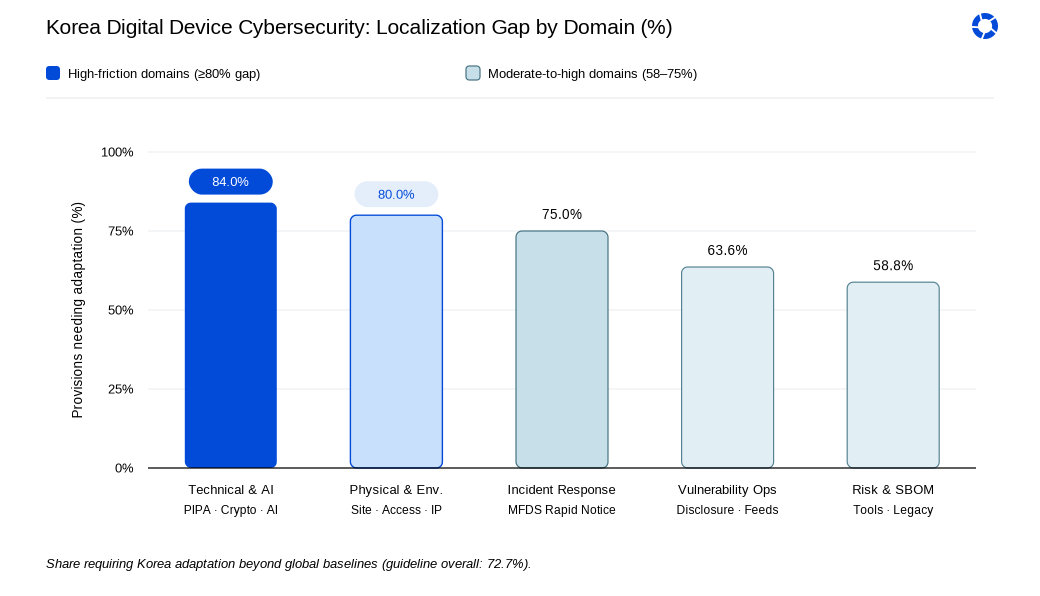
| Operational Domain (Gap Share) | Global Baseline (IEC / IMDRF / FDA / EU) | South Korea Statutory Approach | Commercial & Architectural Impact |
|---|---|---|---|
| Value-Chain & Deployment Environment (Physical & Env.: 80.0%) | Legal manufacturer focused; hospital IT separated as HDO responsibility | Statutorily binds Korean importers and local maintenance vendors, reaching overseas manufacturers via premarket/GMP review and extending into hospital/cloud sites | Requires manufacturer–importer security contracts, site readiness checklists, and physical interface controls |
| Technical Friction & Validation (Technical & AI: 84.0%; Risk: 58.8%) | Zero-Trust dynamic remote access, modern password rules, risk-based tool assurance | Standalone key documentation, strict session/remote controls, blanket test-tool validation, anti-rollback tension | Needs configurable Korea profiles, fixed-endpoint remote access, and formal tool qualification |
| Domestic Privacy Convergence (PIPA) (Embedded in Technical Controls) | Device review separated from regional privacy statutes (HIPAA, GDPR) | Embeds Korea's Personal Information Protection Act (PIPA) directly into device and GMP review | Requires PIPA access-log retention, periodic audits, identifier encryption, and irreversible disposal |
| Statutory AI Security Mandate (Premarket & Digital GMP) | Emerging frameworks (ISO/IEC 27090, phased EU AI Act, draft FDA guidance) | Binding adversarial AI defenses, training-data governance, failsafes, and runtime checks | Demands AI security risk files, operational fallback controls, and documented data provenance |
| Post-Market & Disclosure Governance (Incident: 75.0%; Surveillance: 63.6%) | Harm-triggered authority reporting; EU CRA exempts MDR/IVDR devices | Harm-independent rapid notification to MFDS, providers, and users; MFDS consultation to delay disclosure | Requires a Korea rapid-escalation track, local threat feeds, closure reports, and joint drills |
1. Value-Chain and Operational-Environment Accountability
International standards confine manufacturer duties largely to the device itself, leaving hospital infrastructure to healthcare delivery organizations (HDOs). Under Korea's Digital Medical Products Act, direct statutory enforcement applies to Korean-licensed importers (KLHs), domestic manufacturers, and contracted maintenance providers, while overseas developers/manufacturers remain operationally accountable through premarket review, Digital GMP audits, and importer agreements. Together, the framework extends readiness into hospital and cloud deployment environments—requiring site security checklists, unused-interface protection, and verified development/cloud security even for standalone SaMD.
2. Technical and Architectural Friction Points
Mature global engineering architectures commonly encounter four friction points during MFDS and Digital GMP review:
- Cryptographic Governance: Modern international algorithms remain usable for commercial deployments, yet Korea requires standalone cryptographic key-management documentation, standardized implementation validation, and attention to KISA-validated cryptographic expectations in public-sector tenders.
- Authentication, Sessions, and Remote Access: Global defaults—removing periodic credential rotation, allowing multi-device sessions, or supporting dynamic cloud-range remote service—can clash with Korean expectations favoring periodic credential governance, strict concurrent-session blocking, web cookie disclosures, and tightly restricted fixed-endpoint remote maintenance.
- Mandatory Security Test-Tool Validation: Rather than purely risk-based software assurance, South Korea mandates formal validation and qualification records for security and vulnerability testing tools regardless of software safety class.
- Update Recovery vs. Anti-Rollback: Korea expects both fail-safe recovery if an update fails and strict anti-rollback safeguards blocking downgrades to vulnerable legacy versions—requiring atomic update staging paired with monotonic version controls.
3. Direct Convergence with Domestic Privacy Law (PIPA)
Unlike US HIPAA or EU GDPR—which operate separately from device safety clearance—Korea embeds Personal Information Protection Act (PIPA) controls directly into cybersecurity and Digital GMP assessments. Products processing patient data must incorporate regulated-identifier encryption, immutable access-log retention with periodic audit reviews, controlled administrative decryption, and verified irreversible disposal procedures at decommissioning.
4. World-First Statutory AI Security Mandate
Legacy device cybersecurity standards (IEC 81001-5-1, IEC 62443-4-2, IMDRF N60) do not address adversarial AI threats, while the EU AI Act is phasing in and US FDA AI guidance remains evolutionary. South Korea already enforces binding AI security mandates across both premarket review and Digital GMP audits—covering adversarial defenses (data poisoning, evasion, model extraction), training-data integrity, qualified clinical labeling, de-identification and bias mitigation, operational failsafe/suspension controls with inference logging, and trusted runtime environment checks. Aligning these controls with ISO/IEC 27090 prepares teams simultaneously for Korea and future US/EU expectations.
5. Regulator-Centric Post-Market Incident and Disclosure Governance
Whereas FDA and EU MDR tie mandatory reporting to patient harm or malfunction—and the EU Cyber Resilience Act (CRA) exempts MDR/IVDR medical devices from rapid CSIRT reporting—South Korea requires rapid multi-party notification to MFDS, healthcare providers, and users regardless of confirmed patient harm, followed by formal root-cause closure reporting. Delaying public vulnerability disclosure requires prior MFDS consultation, surveillance must include Korean national threat feeds alongside global databases, and periodic incident drills must include external maintenance partners under extended statutory record-retention rules.
Dual-Market Balance: Global Discipline Plus Clear Partner Accountability
Localizing for Korea should never weaken global cybersecurity rigor. Several reverse gaps remain stricter under US FDA Section 524B, IEC 81001-5-1, and IEC 62443-4-2:
- Preserve Global SBOM & SPDF Discipline: Although Korea currently frames SBOMs as recommended rather than mandatory like US FDA Section 524B, Korea treats SBOM data as protected security information. Keeping a single global SPDF, machine-readable IMDRF N73 SBOM with controlled access, tiered Security Levels, independent penetration testing, exploitability-based threat modeling, formal patching SLAs, and generative AI safeguards (ISO/IEC 27090) protects global approvals while future-proofing against anticipated Korean statutory revisions.
- Delineate Foreign Manufacturer vs. Korean Importer/Distributor Accountability: Because Korean law directly binds domestic importers and maintenance contractors, formal responsibility agreements must divide duties upfront. The foreign manufacturer owns core secure architecture, configurable Korea profiles, key-management documentation, AI validation, test-tool qualification, and rapid upstream incident escalation; the Korean importer/license holder and local partners own localized Digital GMP security procedures, MFDS filings, rapid MFDS notification and disclosure consultations, Korean threat-feed monitoring, site-readiness handoffs, and joint drills.
Executive 4-Phase Korea Localization Playbook
Global SaMD, SiMD, and AI teams can close South Korea's cybersecurity gap without forking codebases through four structured phases.
| Phase | Strategic Objective | Key Executive Workstreams | Target Gate |
|---|---|---|---|
| Phase 1: Gap Diagnostic | Quantify the exact Korea delta over global SPDF assets | Cross-map IEC 81001-5-1, FDA, and MDR files against Korean security, PIPA, and AI mandates; surface clinical-stage triggers early | Pre-submission strategy & clinical readiness |
| Phase 2: Targeted Reconciliation | Resolve technical friction without forking core code | Configure Korea authentication, session, remote-access, and anti-rollback profiles; verify PIPA logging/disposal, AI failsafes, and test-tool qualification | Engineering freeze & verification |
| Phase 3: Dual-Gate Packaging | Align premarket and Digital GMP deliverables | Consolidate standalone key-management documentation, Korean site-readiness guides, AI governance records, and localized Digital GMP security procedures | Premarket MFDS review & Digital GMP audit |
| Phase 4: Value-Chain Activation | Operationalize post-market compliance across partners | Execute manufacturer–importer–maintenance agreements; activate MFDS rapid notification, disclosure consultation, Korean threat feeds, and joint response drills | Commercial launch & post-market oversight |
Through Leanabl's Korea Medical Device Cybersecurity Advisory and Digital Health & AI Regulatory Positioning practices, global manufacturers convert international SPDF files into MFDS-ready deliverables while minimizing rework. Paired with Korea License Holder (KLH) Governance and Leanabl eQMS Risk Management, teams unify threat modeling, vigilance escalation, and local partner governance—maximizing regulatory predictability and accelerating Time-to-Market.
To align these security controls with Korea's quality-system inspection track, review our Korea Digital Medical Device GMP vs. Global Standards Gap Analysis alongside our briefing on the South Korea MFDS Cybersecurity Guideline 6th Revision (0995-06).
Frequently Asked Questions
Does US FDA Section 524B, EU MDR (MDCG 2019-16), and IEC 81001-5-1 compliance cover South Korea's requirements?
No. Global baselines cover roughly a quarter of Korea's framework directly, leaving 72.7% requiring adaptation or Korea-specific controls—most notably PIPA privacy convergence, statutory AI security obligations, standalone key-management documentation, test-tool validation, deployment readiness, and harm-independent MFDS incident reporting.
How do South Korea's AI cybersecurity mandates differ from global medical device standards?
Legacy standards such as IEC 81001-5-1, IEC 62443-4-2, and IMDRF N60 lack adversarial AI provisions. South Korea enforces legally binding AI defenses across premarket review and Digital GMP audits—covering poisoning, evasion, and model-extraction mitigation, training-data integrity and bias governance, operational failsafes, and runtime verification.
Must foreign manufacturers replace international cryptography or fork their global codebase for Korea?
Standard modern international cryptography remains viable for commercial hospitals alongside standardized validation evidence, though public-sector tenders may evaluate KISA-validated modules. Rather than forking software, manufacturers should keep one global core and deploy Korea-specific session, credential, remote-access, and PIPA logging rules as configurable profiles.
How should overseas manufacturers divide cybersecurity responsibilities with Korean importers or distributors?
Because South Korea's Digital Medical Products Act binds domestic importers and software maintenance vendors directly, standard distribution contracts are insufficient. Parties must execute a dedicated quality and cybersecurity agreement allocating headquarters-to-Korea incident escalation timelines, MFDS rapid notification and disclosure consultation ownership, localized Digital GMP procedures, and joint drill participation.