Quality & QMS
Korea Digital Medical Device GMP vs. Global Standards: Executive Gap Analysis & Market Entry Strategy
Strategic gap analysis of South Korea's 3-tier Digital Medical Device GMP against ISO 13485, IEC 62304, and ISO/IEC 42001 for global SaMD and AI teams.

Why Global Certifications Do Not Waive Korea's Digital GMP
Global MedTech executives often assume ISO 13485, MDSAP, IEC 62304, or ISO/IEC 42001 documentation will waive local GMP audits in South Korea. Under Korea's Digital Medical Products Act and the Ministry of Food and Drug Safety (MFDS) Digital Medical Device Manufacturing and Quality Control Standards, digital devices operate on a separate statutory track with four immediate commercial consequences:
- MDSAP Desk Review Applies to Hardware Only: MDSAP converts overseas inspections into off-site document reviews only for hardware plants; standalone software, embedded digital software, and AI products are excluded.
- Existing KGMP Relief Excludes AI: Conventional medical device or IVD KGMP holders qualify for streamlined review only for non-AI software. Adding AI/ML to a cleared product triggers dedicated Korean audit scrutiny.
- Class I AI Accessories Trigger Full AI Review: Standalone Class I software is GMP-exempt, yet a Class I AI accessory paired with a Class II or higher host device requires full AI GMP review alongside the primary system.
- Separate Track Without Preferential Waivers: Digital GMP cannot be bundled into a joint conventional KGMP audit and offers no "excellent manufacturer" desk-review waiver. Remote audits exist for qualifying software sites, provided applicants arrange live streaming, controlled document access, and local auditor-side interpretation.
Validating scope early via Digital Health & AI Regulatory Positioning prevents misdirected audit preparation and launch delays.
Korea's 3-Tier Modular GMP Architecture & Gap Landscape
South Korea is the first jurisdiction to embed a modular, three-tier digital quality framework directly inside mandatory medical device GMP standards.
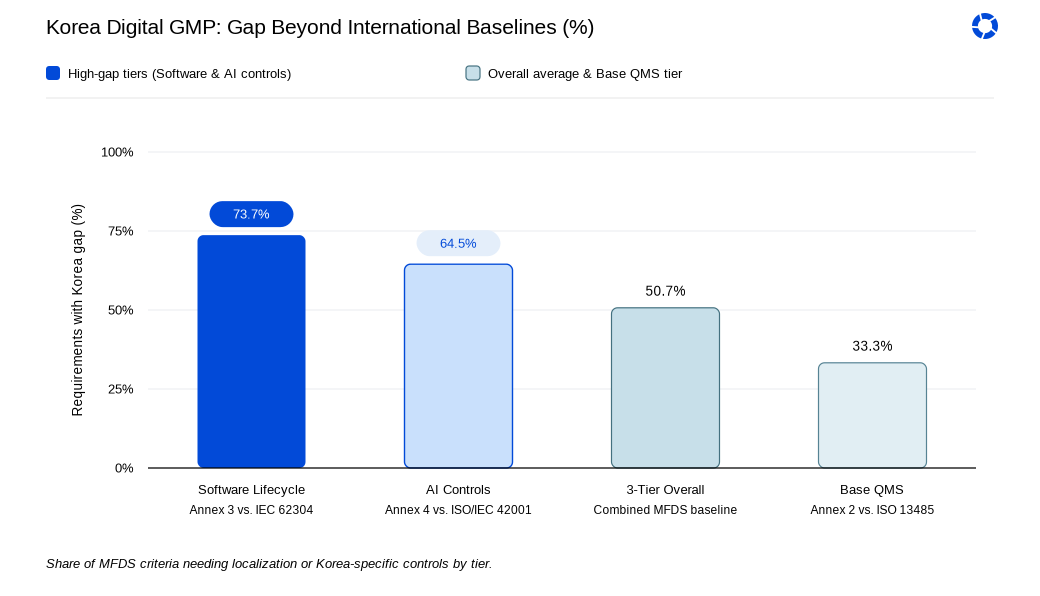
Benchmarking all three tiers against ISO 13485, IEC 62304, IEC 82304-1, ISO/IEC 42001, and IMDRF GMLP shows 50.7% of criteria require adaptation or Korea-specific controls—concentrated in Software Lifecycle (73.7%) and AI Controls (64.5%), compared with 33.3% in Base QMS.
| Digital GMP Tier | International Baseline | Korea Gap | Core Strategic Deltas for Overseas Developers & Manufacturers |
|---|---|---|---|
| Base QMS (Annex 2) | ISO 13485 | 33.3% | Dual 5-year/2-year record retention, auditable SaMD IT/cloud infrastructure, tool CSV & supplier controls, manufacturer final release inspection (domestic statutory Quality Manager & import controls sit with the Korean importer) |
| Software Lifecycle (Annex 3) | IEC 62304 (+ ISO 13485 / IEC 82304-1) | 73.7% | No automatic Class A/B exemptions, broader independent V&V rigor, SaMD design transfer, software outsourcing controls |
| AI Controls (Annex 4) | ISO/IEC 42001 & IMDRF GMLP | 64.5% | External clinical AI governance & decommissioning, three-part reliability proof, open-source license review, AI security, UI bias & disclaimers |
| 3-Tier Overall | Combined Baselines | 50.7% | Stacked conformity within one MFDS Digital GMP audit, interlocked with Korean electronic-intrusion cybersecurity guidelines |
Base QMS Tier (Annex 2 vs. ISO 13485 — Foreign Manufacturer Focus)
Part of Annex 2's overall statutory delta (33.3%) reflects domestic Korean entity mandates—such as registering a legally qualified Korean Quality Manager and managing local traceability or import controls—which apply to the Korean importer rather than an overseas manufacturing site. For overseas SaMD and AI manufacturers audited under Digital GMP, three practical gaps beyond ISO 13485 matter most:
- Dual Record & Obsolete Document Retention: Quality records and obsolete controlled documents for Korea-bound products must be retained for at least five years from manufacture and at least two years after market release (aligned with device life), exceeding ISO 13485's two-year floor.
- Auditable IT, Cloud, Tooling CSV & Supplier Controls for SaMD: Even without a physical plant, overseas software manufacturers must maintain documented development/testing and cloud infrastructure controls, access-controlled work environments, computer software validation (CSV) for quality/engineering tools (eQMS, repositories, CI/CD), and supplier qualification for cloud hosting providers (CSPs) and off-the-shelf software (SOUP).
- Manufacturer Final Release Inspection (Distinct from Design V&V): Standalone SaMD manufacturers cannot skip production and release controls for lack of physical assembly. Final build verification, deployment-package verification, electronic labeling checks, license/account provisioning, and formal release sign-off must be operated as a dedicated manufacturer release inspection that prior design V&V cannot replace (while domestic import quality verification and distribution records are handled separately by the Korean importer).
Software Lifecycle Tier (Annex 3 vs. IEC 62304)
- No Automatic Class A/B Exemptions: Korea's core standard omits automatic class-based exclusions. Class A and B software teams cannot silently omit architecture, detailed design, unit verification, or integration artifacts; they must proactively document risk-based tailoring rationales in their QMS.
- Expanded Independent Verification & Validation: Core design, unit, and integration verification stages expect independent specialist review beyond the design owner plus statistical or sample-size justification. Validation planning must also address performer qualifications, pre-validation training, and clinical evaluation linkage.
- Design Transfer & Outsourcing Governance: Standalone SaaS products require formal release-environment design transfer, paired with explicit software outsourcing controls and written prior-change-notification agreements for contract developers and cloud vendors.
AI Controls Tier (Annex 4 vs. ISO/IEC 42001 & IMDRF GMLP)
- External Clinical Governance & Decommissioning: Where applicable, AI governance must engage external specialists (clinicians, academics, or data scientists) alongside structured oversight of target performance and AI system decommissioning decisions.
- Three-Part AI Reliability Framework: Korea combines three pillars rarely mandated together globally: (1) virtual or simulated test environments to bound output uncertainty, (2) a cross-functional expected-output consensus body (R&D, quality, regulatory, security) to curb confirmation bias, and (3) a separate user evaluation panel of practicing clinicians confirming unambiguous output interpretation.
- Open-Source Licensing, Adversarial Security & Human Factors: Third-party AI libraries are audited for community maintenance activity and commercial license compliance (such as copyleft limits) alongside vulnerabilities and SBOMs. AI GMP also interlocks with MFDS Security Guidelines for Electronic Intrusion of Digital Medical Devices against data poisoning, model extraction, and evasion—while requiring source-code and UI automation-bias mitigation, drift alerts, reproducible logs (including offline hospital deployments), and explicit clinical disclaimers.
Strategic Role Split: Developers, Manufacturers & Korean Importers
A frequent mistake in Korea market entry is conflating overseas manufacturer GMP audit requirements with Korean importer (KLH) statutory licensing and domestic quality obligations. Separating these mandates upfront eliminates unnecessary rework and compliance blind spots:
| Dimension | Overseas Developer / Manufacturer | Korean Importer / KLH | Commercial Distributor |
|---|---|---|---|
| Statutory Role & Lead | Audited manufacturing site for Digital GMP (retains ISO 13485 Management Representative; not required to register a Korean statutory Quality Manager) | Statutory GMP applicant & Importer License holder (must appoint and register a legally qualified Korean Quality Manager with local education compliance) | Commercial sales, channel rollout, and frontline support (best decoupled from statutory license holding) |
| Quality & Release Duties | Operates Annex 2/3/4 QMS, SW & AI controls, 5-year/2-year retention addendum, SaMD infrastructure/CSV, and manufacturer final release inspection | Operates domestic importer quality system (GIP), performs import quality verification using manufacturer release records, and maintains domestic distribution/tracking records (where applicable) | Coordinates hospital rollout and escalates customer complaints, defects, and incidents promptly to the importer |
| Audit & Lifecycle Scope | Supplies original English QMS/SW/AI files, hosts site/remote walkthrough, and notifies importer ahead of AI, site, or outsourcing changes | Files Korean applications & mapping guides, arranges audit/interpreter logistics, manages 3-year renewals, and leads MFDS safety/security reporting | Gathers market feedback and supports importer-led field safety actions and updates |
- Decoupling KLH Ownership from Distribution: The local importer—subsidiary, independent Korea License Holder (KLH), or distributor—is the statutory GMP applicant owning filings, domestic quality management, post-market reporting, and three-year renewals. Separating license ownership from commercial distribution prevents channel lock-in.
- Original English QMS Documentation: Foreign manufacturers do not need full Korean translations of global QMS or engineering files. Reviewers accept core foreign documentation in original English alongside mandatory Korean forms and a structured Korean cross-reference guide—and Leanabl works directly from English originals with zero additional translation fees for English documentation.
- Change Triggers & Reverse Gaps: Adding AI/ML to cleared software, relocating development sites, or outsourcing core engineering can trigger change audits or supplier inspections. Meanwhile, teams launching concurrently in the United States and Europe should build one unified QMS to cover reverse gaps beyond Korea's Digital GMP—including US FDA QMSR complaint/service/labeling rules, US FDA PCCP iterative update plans, EU MDR PRRC and post-market reporting, ISO/IEC 42001 societal impact assessments, EU AI Act human-override and registry duties, and generative AI controls.
Four-Phase Market-Entry Readiness Roadmap
Global SaMD and AI teams can close Korea's three-tier gaps predictably without slowing core product releases:
| Phase | Strategic Focus | Key Executive Deliverables | Core Stakeholders |
|---|---|---|---|
| Phase 1: Scoping & Governance | Lock track & entity roles | Confirm Annex 2/3/4 scope (including AI accessories), remote-audit setup, and importer/KLH structure | Leadership, RA/QA, Legal, KLH |
| Phase 2: Gap Assessment | Isolate high-risk deltas | Benchmark ISO 13485, IEC 62304, ISO/IEC 42001, and security files via KGMP Pre-Audit Gap Analysis | Global QA/RA, Engineering, AI Leads |
| Phase 3: Korea Addendum | Bridge gaps without rebuild | Issue Korea addendum (retention, safety-class tailoring, supplier clauses), assemble AI reliability evidence, and map English files | Global QA, R&D, Clinical Advisors, InfoSec |
| Phase 4: Audit & Lifecycle Sync | Pass audit & govern changes | Execute Foreign Manufacturer KGMP Certification, align MFDS authorization, and embed AI change-trigger and three-year renewal tracking | Global QA/RA, Importer/KLH, Product |
For the parallel cybersecurity and AI-defense requirements audited alongside Digital GMP, see our South Korea Digital Medical Device Cybersecurity Gap Analysis; for structuring Korean importer accountability without distributor lock-in, see our Commercial Distributor vs. Independent KLH vs. Korean Subsidiary Comparison.
Frequently Asked Questions
Can ISO 13485, MDSAP, or ISO/IEC 42001 waive Korea's Digital Medical Device GMP audit?
No. MDSAP standalone desk review applies strictly to hardware medical devices. Software and AI products cannot use MDSAP or ISO/IEC 42001 to waive Korean Digital GMP conformity assessment, and existing general KGMP certificates support streamlined review only for non-AI software.
Why does Software Lifecycle (Annex 3) show a 73.7% gap against IEC 62304, and how should Class A or B teams respond?
Annex 3 blends IEC 62304 with ISO 13485 design-transfer and outsourcing controls plus IEC 82304-1 validation concepts, while omitting explicit Class A/B exemptions. Lower-risk teams should document a risk-based safety-classification and tailoring rationale inside their QMS rather than silently skipping deliverables.
Must foreign SaMD and AI manufacturers translate all English QMS files into Korean?
No. Korean reviewers accept overseas quality manuals, SOPs, software files, and AI technical records in original English when paired with mandatory Korean application forms and a clear Korean cross-reference guide—saving weeks of translation time and cost.
How are Digital GMP duties split between an overseas developer and a Korean distributor or importer?
The overseas developer or manufacturer operates and evidences the QMS, software lifecycle, cybersecurity, AI controls, and manufacturer final release inspection (retaining its ISO 13485 Management Representative rather than registering a Korean statutory Quality Manager). The Korean importer (subsidiary, independent KLH, or distributor) acts as the statutory applicant owning Korean importer licensing, statutory Korean Quality Manager appointment, domestic import quality management (GIP), filings, audit coordination, post-market reporting, and three-year renewals.