Korea
South Korea MFDS Cybersecurity Guideline 6th Revision (0995-06): Key Changes Explained
A clear, high-level overview of South Korea MFDS Medical Device Cybersecurity Guideline-0995-06 (effective Oct 30, 2026), covering flexible authentication rules, clearer validation criteria, and practical manufacturer steps.

Background & Three Core Changes
Rather than adding brand-new security controls, the 6th Revision (Guideline-0995-06) refines practical friction points observed over the first year of South Korea's 35-item cybersecurity review regime. Its regulatory direction is straightforward: align rigid authentication rules with global clinical standards, while clarifying documentation rules where submissions most frequently stalled.
1. Practical Authentication Flexibility: Ending Unnecessary Firmware Modifications
Under the previous revision, reviewers effectively expected forced periodic password expiration timers and consumer-style alphanumeric/special-character password strings. As a result, global devices already cleared in the US or Europe often faced Korean review holds simply because their firmware lacked a 90-day password expiration prompt or used a numeric keypad.
Guideline-0995-06 removes the requirement to force periodic credential changes (IA-04), aligning with modern international standards (NIST, IEC, FDA, and EU MDCG) that warn against locking clinicians out during urgent care. In addition, MFDS now explicitly accepts password rules tailored to product risk and hardware characteristics (IA-05), enabling devices with compact touchscreens or numeric pads to justify PIN-based access when paired with compensating safeguards such as failed-login lockouts and session timeouts.
2. Clearer System Integrity Evidence: Preventing High-Frequency Review Holds
While authentication became more flexible, MFDS tightened documentary clarity across the two System Integrity controls that generated the most frequent requests for supplementary information:
- Documenting Non-Applicable Input Validation Vectors (
SI-05): Manufacturers must evaluate all six external input threat vectors (out-of-range values, invalid characters, incomplete data/buffer overflow, SQL injection, XSS, and malformed packets). If specific vectors such as SQL injection or XSS do not apply because the device uses neither a database nor a web engine, applicants cannot simply skip them—the architectural reason must be explicitly recorded in the Design Document or Risk Management Document. - Mandatory User Error Message Catalog (
SI-07): MFDS separated login-prompt masking (handled underIA-06) from system error handling and elevated a complete list of user-returned error messages—defined in the Design Document or Instructions for Use (IFU)—into a mandatory pass criterion so reviewers can verify that internal paths or system details are never exposed.
3. Retirement of the Legacy 13-Item Grace Appendix
MFDS deleted the six-page transition appendix (reducing the guidance from 76 to 70 pages) that had temporarily cross-walked pre-2025 13-item rules through June 2025. Every new submission across medical devices, IVDs, and digital medical products is now evaluated solely under the unified 35-item cybersecurity checklist.
Overall Verification Load & Revision Comparison
Looking across the entire guideline shows where engineering and QA effort actually sits: although the checklist lists 35 items, software verification reports (SW V&V) must satisfy 96 individual pass criteria (2.7x the item count), with more than half of the total verification workload (54.2%) concentrated in System Integrity (SI, 30.2%) and Use Control (UC, 24.0%).
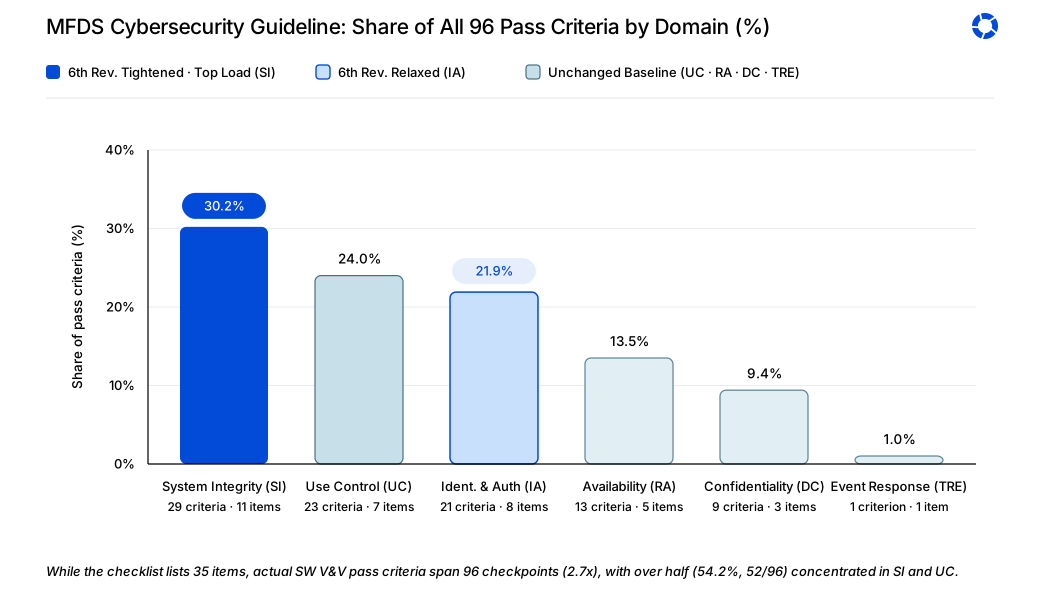
- Clarifying the Heaviest Testing Domain (
SI,30.2%): MFDS focused its stricter documentation rules (SI-05andSI-07) directly inside System Integrity, which carries the highest concentration of pass criteria (29of96). - Streamlining Global Reuse in
IA(21.9%): Conversely, removing Korea-specific password locks in Identification and Authentication (IA,21criteria) allows manufacturers to reuse existing FDA and EU test evidence far more smoothly.
| Area | Previous (Guideline-0995-05) |
Revised (Guideline-0995-06) |
Practical Impact for Manufacturers |
|---|---|---|---|
Password Rotation (IA-04) |
Required forced periodic credential changes | Removed "periodic" mandate; checks capability to change credentials | Global devices without 90-day expiration timers pass without firmware redesign |
Password Strength (IA-05) |
Referenced domestic consumer/network IoT password rules | Accepts password policies based on risk level and device traits | Numeric-keypad and touchscreen devices can justify PIN rules via risk management |
Input Validation (SI-05) |
Listed 6 vectors without rules for omitted items | Evaluate all 6 vectors + record N/A rationale in Design/Risk Docs | Prevents review holds when skipping SQLi/XSS on embedded non-web devices |
Error Handling (SI-07) |
Overlapped login prompts; error list was only an example | Decoupled from login prompts; complete user error list now mandatory | Must include a full user-facing error message table in the Design Doc or Korean IFU |
| Checklist Framework | Included expired 13-item transition appendix (76 pages) | Deleted legacy appendix; unified 35-item checklist (70 pages) | Retire all legacy 13-item templates across medical, IVD, and digital submissions |
Affected Device Scope
Any standalone software or software/firmware-containing hardware medical device with wired or wireless communication paths falls within scope.
| Device Category | Typical Examples | Key Submission Focus |
|---|---|---|
| Standalone Software (SaMD) & AI Devices | AI diagnostic software, digital therapeutics, mobile/cloud clinical apps | Full 35-item mapping, all 6 input validation vectors (including API/web checks), complete UI error catalog, and SBOM vulnerability review |
| Networked Medical & IVD Hardware | Hospital LAN, Wi-Fi, or Bluetooth patient monitors and IVD analyzers | Leverage on-demand password change (IA-04) and risk-based keypad/touch rules (IA-05); verify protocol fuzzing and error catalogs |
| Local Wired-Port Hardware | Offline devices equipped with USB, RS-232, SD card, or service ports | Apply interface-relevant items; document non-web/non-DB architecture in Design/Risk files for SI-05 while testing port boundary/packet inputs |
| Post-Approval Change Filings | Marketed devices adding connectivity or updating core security/OS software | Not retroactive for unchanged licenses, but applies immediately to technical file change reviews involving communication or security updates |
3 Practical Steps for Manufacturers
Foreign manufacturers and Korea License Holders (KLH) preparing upcoming filings can streamline readiness in three high-level steps:
1. Reassess Global Test Report Reusability Before Touching Firmware
Before commissioning Korea-specific software changes, evaluate your existing US FDA or EU MDR cybersecurity reports through a Korea cybersecurity compliance review. Devices without forced password expiration timers or full keyboards can now satisfy IA-04 and IA-05 by linking existing verification evidence with compensating risk controls in an eQMS risk management framework.
2. Close Input Validation N/A Gaps and Compile the Error Catalog Early
Prevent avoidable review holds through an upfront medical device cybersecurity engineering check focused on two deliverables: (1) confirm that any inapplicable SI-05 input vectors (such as SQL injection or XSS on embedded firmware) are explicitly justified in your Design or Risk Management Document, and (2) verify that a complete table of user-facing error messages (SI-07) is included without exposing internal system paths.
3. Align Korean IFU Wording and Screen Post-Market Changes
Korean reviewers cross-check cybersecurity dossiers against the Korean technical file and Instructions for Use (IFU). Prior to Korea technical file registration, ensure password instructions and user error tables match the Korean IFU, and evaluate planned firmware updates on marketed products through structured change notification and license amendment management.
Frequently Asked Questions
Do medical devices still need a forced 90-day password expiration timer to pass Korean MFDS review?
No. The 6th Revision removed the requirement for forced periodic rotation. As long as authorized users or administrators can change credentials when needed, devices pass IA-04 without automatic expiration timers—just be sure to map your test report directly to the updated pass criterion rather than older illustrative examples.
Must hardware devices with numeric keypads or small touchscreens enforce complex special-character passwords?
No. MFDS now explicitly accepts password policies established according to device risk and hardware characteristics. Manufacturers can justify a numeric PIN or tailored login method in their Design and Risk Management Documents by pairing it with compensating controls such as failed-login lockouts and automatic session locks.
How should embedded devices without a web browser or SQL database handle SQL injection and XSS checks?
You do not need to run web or database injection tests on hardware that lacks those components, but you cannot leave those items unexplained. Simply record the architectural absence of a web or SQL engine in your Design or Risk Management Document, and submit test results for the remaining applicable vectors such as out-of-range inputs, buffer overflows, and malformed packets.
Does Guideline-0995-06 require immediate re-review for devices already approved and sold in South Korea?
No. The revised guideline applies to new pre-market submissions from October 30, 2026 onward and does not require retroactive re-filing for unchanged marketed products. However, if you later submit a technical file change application that adds connectivity or modifies software security architecture, the 6th Revision criteria will apply.